Building inside the rock (without touching it)
May 28, 2026
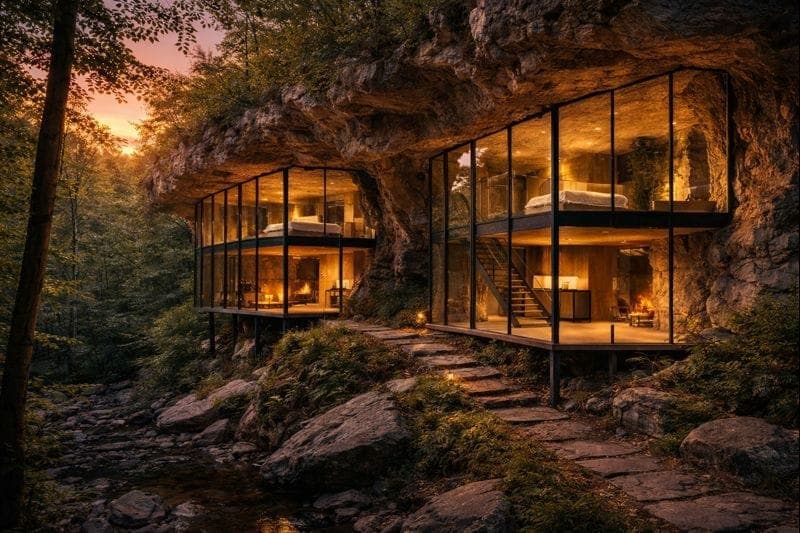
I get a version of the same question every time I describe the cave units to someone.
"Wait. Are you drilling into the rock?"
No. The sandstone overhangs at Cavara's 11.5 acres were shaped by 350 million years of water moving through the Gorge. They already exist as sheltered spaces. Our job isn't to carve anything out. It's to enclose what's already there.
Here's what that actually looks like. The natural rock overhang forms the ceiling and back wall. We place a glass curtain wall up against the open face of the overhang, sealing against the rock to create the enclosure. The steel frame transfers the structural load to the ground. The rock itself isn't drilled, excavated, or modified in any way. The sandstone stays exactly as the Gorge left it.
Inside, you have raw rock overhead. A loft sleeping area above. A kitchen, a living space, and floor-to-ceiling glass looking straight into the forest.
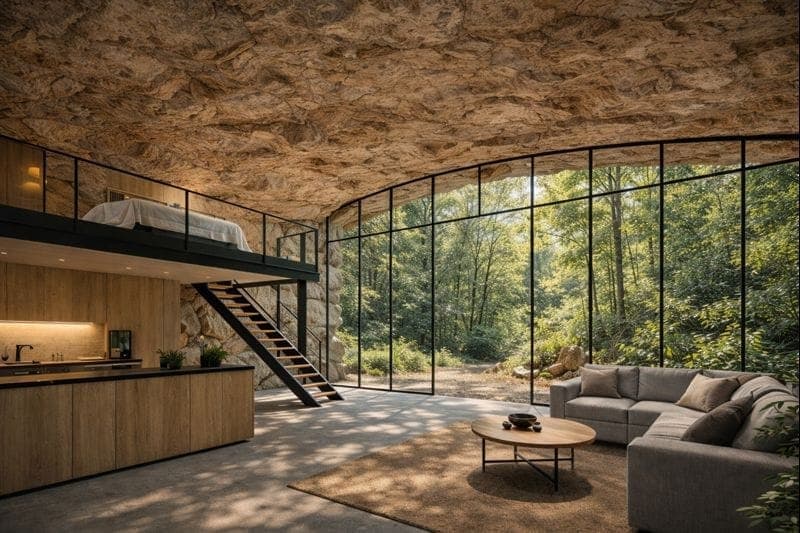
The geotechnical firm we brought on isn't there to help us build into the rock. They're there to make sure we understand it. Where the drip line falls (the point past which rainwater runs off the overhang). How drainage moves around and beneath the structure. How the rock face behaves over time. Build inside the drip line and you've got a moisture problem baked into the structure permanently. Understand it correctly first and the overhang does what overhangs have always done.
With the treehouses, the engineering challenge is elevation. With the cave units, the challenge is knowing exactly where not to touch anything.
That same principle drove how I handled the regulatory side of this project.
I went wider than most developers would bother to go. Before any construction planning, I contacted the Powell County Fiscal Court, the Judge Executive's office, the Kentucky Property Valuation Administrator, the state building code office, the Powell County Floodplain Coordinator, the Kentucky Department of Fish and Wildlife Resources, the U.S. Fish and Wildlife Service, and the Daniel Boone National Forest. Nine agencies. All confirmed in writing.
The reason is simple. A last-minute surprise from a regulatory body mid-construction is not a cost I'm willing to build on top of. Every written confirmation I received is a document on file.
What came back: no county zoning, no county building codes, no county permits required, no flood hazard designation, no federal involvement needed on privately owned land. Clear territory at every level we asked about.
That doesn't mean the work is done. It means we asked the right questions before we started.
More soon,
Jeremy
Get the next letter when it is written. Join the newsletter.